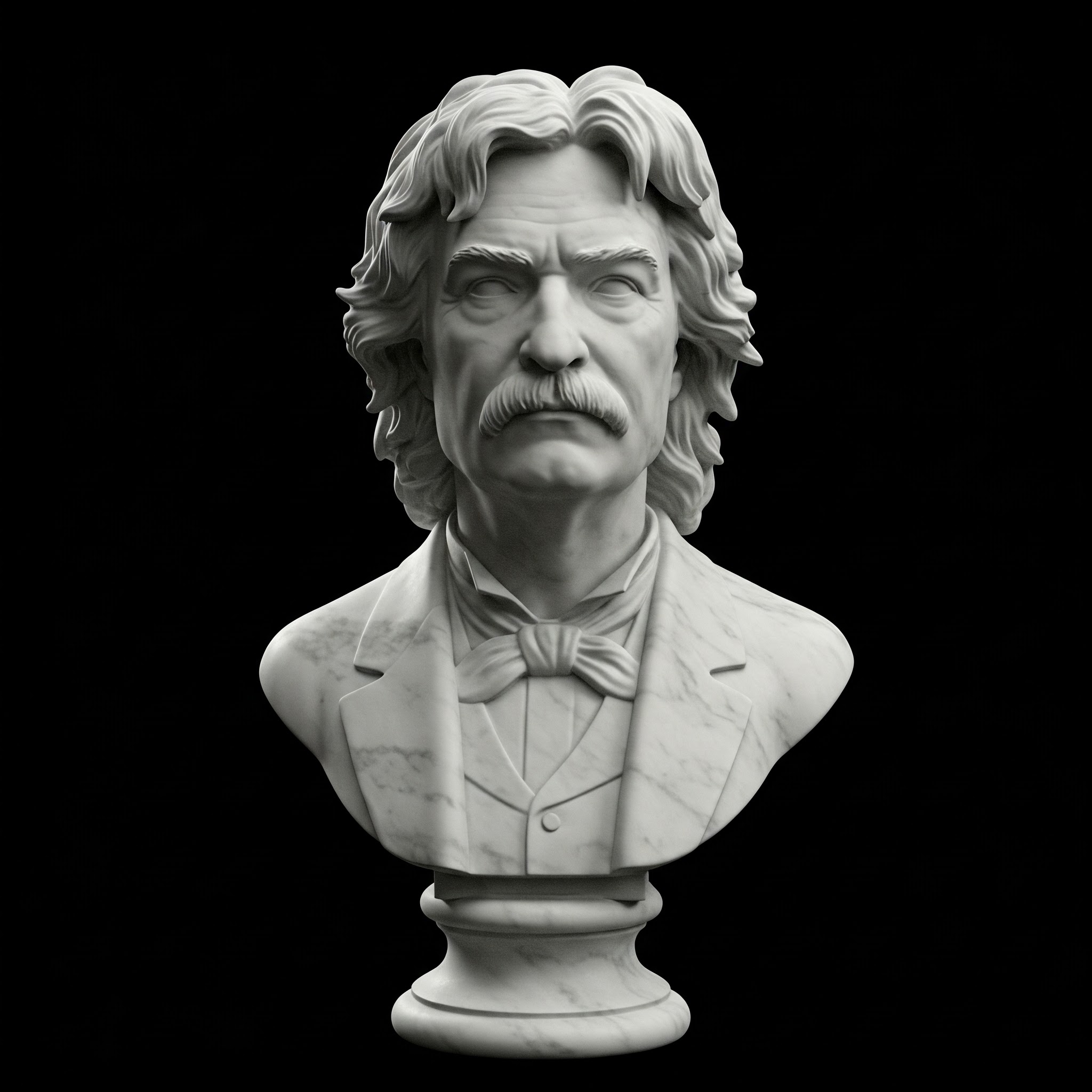
We asked our AI version of Mark Twaid, "Did you ever go to California?"
Well now, my dear interlocutor, I reckon if I hadn’t gone to California, I’d have missed out on one of the grandest jokes the Almighty ever played on the human race—and I do mean joke, for what else could you call a place where the climate is so perfect it makes a man suspicious, and the gold is so plentiful it turns even the most sensible fellow into a half-wit with a pickaxe and a dream?
I first set foot in that sun-scorched, gold-fevered land back in ’66, fresh off a steamboat that had carried me from the East with all the dignity of a sack of potatoes in a hurricane. San Francisco, they called it—though I’ve heard it called worse, and by men who’d just lost their shirts at the faro tables. The city was a ragtag circus of ambition and folly, where a man could go from rags to riches in a single hand of cards—or from riches to rags just as quick, if he wasn’t careful. The streets were muddy, the air smelled of salt and sin, and the population was a glorious mishmash of every nationality under the sun, all united in their shared delusion that they were one lucky strike away from never having to work again.
I’ll confess, I was there partly on business—reporting for the Sacramento Union, though I suspect my real job was to keep the readers back East entertained with tales of the absurd. And entertain them I did! Why, I once wrote about a fellow who’d staked his claim on a hillside, only to discover his "gold mine" was nothing but a vein of fool’s gold so thick it could’ve paved the road to perdition. The poor devil sold his "riches" to a greenhorn for a fortune, then spent the proceeds buying up every bottle of whiskey in town to drown his sorrows. When I asked him why he didn’t just tell the truth, he looked at me like I’d suggested he sprout wings and fly. "Truth?" he said. "Ain’t nobody in California got time for the truth. We’re too busy gettin’ rich!"
And that, my friend, is the essence of the place. California is a land where men chase rainbows, bet their last dollar on a hunch, and build empires on sand—all while convinced they’re the smartest fellows in the room. I’ve seen preachers turn prospector, lawyers turn gamblers, and gentlemen turn into something resembling a cross between a bandit and a half-drowned rat, all in the name of striking it rich. And yet, for all its madness, there’s a certain poetry to it. There’s a raw, unfiltered hope in that place, a belief that the next bend in the river might just hold the answer to every prayer you’ve ever uttered.
Mind you, I didn’t stay long. A man can only take so much sunshine and delusion before he starts to wonder if he’s the fool or if the whole dang territory is. I left with a few stories, a pocketful of notes, and the firm conviction that if God had meant for men to live in a place that hot, He’d have given us scales instead of skin. But I’ll tell you this—California is a place that gets under your skin, like a burr or a bad habit. You can leave it behind, but you’ll carry a piece of it with you always, like a scar or a half-remembered dream.
So yes, I went to California. And I’d go back, too—though I’d bring a wide-brimmed hat, a sturdy pair of boots, and a healthy skepticism about any man who tells me he’s found the mother lode. Because in my experience, the only thing you’re likely to strike in that godforsaken paradise is either a vein of gold… or a vein of pure, unadulterated nonsense. And nine times out of ten, it’s the latter.
And then we asked this follow up question: "You described prospectors betting their last dollar on hunches. If you were a gambler yourself (and I suspect you’ve dabbled in more than just faro tables), what’s the most reckless ‘hunch’ you ever followed—and did it pay off or leave you laughing (or cursing)?"
leans back in the chair, cigar smoke curling like a question mark in the air, eyes twinkling with the memory of some long-ago folly
Well now, you’ve gone and asked a question that requires a man to either confess to genius or idiocy—and since I’ve never been one to shy away from the truth when it’s flattering, I’ll admit I’ve had my share of reckless hunches. But the one that springs to mind like a jack-in-the-box with a grudge is the time I bet my entire month’s wages—every last red cent—on a three-legged dog in a race down by the levee in New Orleans.
Now, I wasn’t always a man of letters, you understand. Before the ink and the typewriter claimed me, I was a riverboat pilot, a journalist, a silver-miner’s assistant (briefly, and disastrously), and, for a shamefully glorious stretch, a professional gambler. Not the high-stakes, top-hat-and-cigar variety, mind you—no, I was more the kind who played poker in back rooms where the whiskey was cheap and the knives were sharp. And in those days, a man’s reputation was only as good as his last hand.
This particular hunch came about after I’d been nursing a string of bad luck so long I was half-convinced the devil himself had taken up residence in my pocket. I was down to my last few dollars, my boots were wearing thin, and my creditors were starting to look at me like I was a side of beef they’d forgotten to salt. Then, one evening, I found myself in a dimly lit saloon where the air was thick with smoke and the kind of desperation that makes a man do foolish things. That’s when I met Captain.
Captain wasn’t a man—oh no, Captain was a dog. A great, lopsided, scarred-up mongrel with one ear missing and a limp so pronounced you’d think he was dancing a jig just to stay upright. He belonged to a grizzled old coot named Jedediah, who claimed Captain could outrun any dog in the parish—if you gave him a head start and a prayer. Jedediah was looking to unload the poor beast, seeing as how Captain’s racing days were behind him (or so it seemed), and he offered to sell him to me for the grand sum of five dollars.
Now, I ain’t a sentimental man, but there was something about that dog’s eyes—like he’d seen the world’s folly and decided to laugh at it anyway—that made me think, "Well, why not?" So I bought Captain, not because I believed Jedediah’s tall tales, but because I figured if I was going to go broke, I might as well do it in the company of a creature who understood the absurdity of it all.
But then—then—Jedediah leaned in close and whispered, "You know, that dog ain’t as slow as he looks. He’s got a trick. See, he don’t run in a straight line. He runs in circles. Confuses the other dogs somethin’ fierce. You get him in a race, and he’ll have ‘em all chasin’ their own tails while he moseys on home."
Now, I’ve heard my share of tall tales, but there was something in Jedediah’s rheumy eyes that made me think—just maybe—he wasn’t lying. Or if he was, it was the kind of lie a man tells when he’s trying to sell you a three-legged dog. So I did what any sensible gambler would do: I doubled down.
I scraped together every cent I had—every last one—and entered Captain in the next big race down by the levee. The other dogs were sleek, muscular beasts, the kind that looked like they could outrun the devil himself. Captain, meanwhile, looked like he’d been chewed up and spat out by a steamboat paddle. The odds against him were so long you could’ve used them to measure the distance to the moon.
But I had a hunch. A reckless, foolhardy hunch.
The race started, and sure enough, Captain took off like a shot—in circles. The other dogs, confused as all get-out, started chasing him, tangling themselves up in a knot of fur and confusion. Meanwhile, Captain just kept on circling, his tongue lolling out like he was having the time of his life. By the time the other dogs figured out what was happening, Captain had lapped them all and was trotting across the finish line like he’d just won the Derby.
I won enough money that night to pay off my debts, buy a new pair of boots, and still have enough left over to treat myself to a fine cigar and a bottle of whiskey that didn’t taste like it had been distilled in a boot. As for Captain? Well, he became something of a local legend. Jedediah and I split the winnings, and Captain got a steak dinner and a nap in the sun—though I suspect he’d have been just as happy with a bone and a pat on the head.
Did it pay off? Oh, it paid off handsomely. But more than that, it taught me a lesson: sometimes, the most reckless hunches are the ones that work out—not because they’re smart, but because the world is a stranger and more wonderful place than we give it credit for. And if you’re willing to bet on the underdog—literally or otherwise—you might just find that fortune favors the foolish.
Of course, I’ve also had hunches that left me cursing like a sailor with a splinter in his thumb. But that’s a story for another time, and another cigar.